Wayang is an Indonesian word for theatre When the term is used to refer to kinds of puppet theater, sometimes the puppet itself is referred to as wayang. Performances of shadow puppet theater are accompanied by gamelan in Java, and by "gender wayang" in Bali.
UNESCO designated Wayang Kulit, a shadow puppet theater and the best known of the Indonesian wayang, as a Masterpiece of Oral and Intangible Heritage of Humanity on 7 November 2003. In return of the acknowledgment, UNESCO demanded Indonesia to preserve their heritage.
Wayang kulit, shadow puppets prevalent in Java and Bali in Indonesia, are without a doubt the best known of the Indonesian wayang. Kulit means skin, and refers to the leather construction of the puppets that are carefully chiseled with very fine tools and supported with carefully shaped buffalo horn handles and control rods.
The stories are usually drawn from the Ramayana, the Mahabharata or the Serat Menak.
There is a family of characters in Javanese wayang called Punakawan; they are sometimes referred to as "clown-servants" because they normally are associated with the story's hero, and provide humorous and philosophical interludes. Semar is the father of Gareng (oldest son), Petruk, and Bagong (youngest son). These characters did not originate in the Hindu epics, but were added later, possibly to introduce mystical aspects of Islam into the Hindu-Javanese stories. They provide something akin to a political cabaret, dealing with gossip and contemporary affairs.
The puppet figures themselves vary from place to place. In Central Java the city of Surakarta (Solo) is most famous and is the most commonly imitated style of puppets. Regional styles of shadow puppets can also be found in West Java, Banyumas, Cirebon, Semarang, and East Java. Bali produces more compact and naturalistic figures, and Lombok has figures representing real people. Often modern-world objects as bicycles, automobiles, airplanes and ships will be added for comic effect, but for the most part the traditional puppet designs have changed little in the last 300 years.
Wayang Kulit is a unique form of theatre employing light and shadow. The puppets are crafted from buffalo hide and mounted on bamboo sticks. When held up behind a piece of white cloth, with an electric bulb or an oil lamp as the light source, shadows are cast on the screen.
Wayang Kulit plays are invariably based on romantic tales, especially adaptations of the classic Indian epics, "The Mahabarata" and "The Ramayana". Some of the plays are also based on local happenings (current issues) or other local secular stories. It is up to the conductor or "Tok Dalang" to decide his direction.
Historically, the performance consisted of shadows cast on a cotton screen and an oil lamp. Today, the source of light used in wayang performance in Java is most often a halogen electric light. Some modern forms of wayang such as Wayang Sandosa created in the Art Academy at Surakarta (STSI) has employed spotlights, colored lights and other innovations.
The handwork involved in making a wayang kulit figure that is suitable for a performance takes several weeks, with the artists working together in groups. They start from master models (typically on paper) which are traced out onto kulit (skin or parchment), providing the figures with an outline and with indications of any holes that will need to be cut (such as for the mouth or eyes). The figures are then smoothed, usually with a glass bottle, and primed. The structure is inspected and eventually the details are worked through. A further smoothing follows before individual painting, which is undertaken by yet another craftsman. Finally, the movable parts (upper arms, lower arms with hands and the associated sticks for manipulation) mounted on the body, which has a central staff by which it is held. A crew makes up to ten figures at a time, typically completing that number over the course of a week.
The painting of less expensive puppets is handled expediently with a spray technique, using templates, and with a different person handling each color. Less expensive puppets, often sold to children during performances, are sometimes made on cardboard instead of leather.


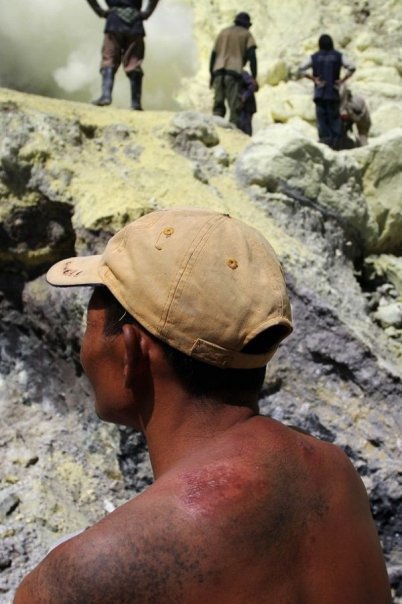


The Ijen volcano complex is a group of stratovolcanoes, in East Java, Indonesia. It is inside a larger caldera Ijen, which is about 20 kilometers wide. The Gunung Merapi stratovolcano is the highest point of that complex. (not to be confused with Mount Merapi, Central Java aka Gunung Merapi)
West of Gunung Merapi is the Ijen volcano, which has a one-kilometer-wide turquoise-colored acid crater lake. The lake is the site of a labor-intensive sulfur mining operation, in which sulfur-laden baskets are carried by hand from the crater floor. Many other post-caldera cones and craters are located within the caldera or along its rim. The largest concentration of post-caldera cones forms an E-W-trending zone across the southern side of the caldera. The active crater at Kawah Ijen has an equivalent radius of 361 meters, a surface of 41 × 106 square meters. It is 200 meters deep and has a volume of 36 × 106 cubic meters.
In 2008, explorer George Kourounis took a small rubber boat out onto the acid lake to measure its acidity. The pH of the sulfuric acidin the crater was measured to be 0.5


Padang food is famous for its rich taste of succulent coconut milk and spicy chili.Among various cooking traditions within Indonesian cuisine, Minangkabau cuisine and most of Sumatran cuisine, demonstrate Indian and Middle Eastern influences, which is various dishes cooked in curry sauce with coconut milk, also the heavy use of spices mixture.
Because most of Minangkabau people are muslims, Minangkabau cuisine follows halal dietary law rigorously. Protein intake are mostly taken from beef, water buffalo, goat, and lamb meat, and also includes poultry and fishes. Minangkabau people are known for their fondness of cattle meat products including offal. Almost the whole parts of a cattle, such as meat, ribs, tongue, tail, liver, tripe, brain, bone marrow, spleen, intestine, cartilage, tendon, and even skin, are made to be Minangkabau delicacies. Seafood is popular in coastal West Sumatran cities, and most are grilled or fried with spicy chilli sauce or in curry gravy. Various of fishes, shrimp, and cuttlefish in also cooked in similar fashion. Most of Minangkabau food is eaten with hot steamed rice or compressed rice such as katupek (ketupat). Vegetables are mostly boiled such as boiled cassava leaf, or simmered in thin curry as side dishes, such as gulai (some kind of curry) of young jackfruit or cabbages.
In Padang food establishments, it is common to eat with one's hands. They usually serve kobokan, a bowl of tap water with a slice of lime or basil leaf in it to give a fresh scent. This bowl of water with lime in it should not to be consumed, however; it is used to wash one's hand before and after eating. If a customer do not wished to eat with bare hands, it is acceptable to ask for spoon and fork instead.
well mean while me and my brother mas tedja are craving about padang food so we make it our self Padang Food, Since mas Tedja can't eat so much Spicy food, so i decide to make a milder spice one


"indonesia a must Condiment" SAMBAL


Bali is an Indonesian island located in the westernmost end of the Lesser Sunda Islands, lying between Java to the west and Lombok to the east. It is one of the country's 33 provinces with the provincial capital at Denpasar towards the south of the island.
With a population recorded as 3,551,000 in 2009,[2] the island is home to the vast majority of Indonesia's small Hindu minority. About 93.2% of Bali's population adheres to Balinese Hinduism, while most of the remainder follow Islam. It is also the largest tourist destination in the country and is renowned for its highly developed arts, including dance, sculpture, painting, leather, metalworking, and music.
Source http://en.wikipedia.org/wiki/Bali


Galungan is a Balinese holiday that occurs every 210 days and lasts for 10 days. Kuningan is the last day of the holiday. Galungan means "When the Dharma is winning." During this holiday the Balinese God visit the Earth and leave on Kuningan
Occurring once in every 210 days in the pawukon (Balinese cycle of days), Galungan marks the beginning of the most important recurring religious ceremony that is celebrated by all Balinese. During the Galungan period the deified ancestors of the family descend to their former homes. They must be suitably entertained and welcomed, and prayers and offerings must be made for them. Those families who have ancestors that have not yet been cremated, but are still buried in the village cemetery, must make offerings at the graves.
Although Galungan falls on a Wednesday, most Balinese will begin their Galungan 'holiday' the day before, where the family is seen to be busily preparing offerings and cooking for the next day. While the women of the household have been busy for days before creating beautifully woven 'banten' (offerings made from young coconut fronds), the men of our village usually wake up well before dawn to join with their neighbours to slaughter a pig unlucky enough to be chosen to help celebrate this occasion. Then the finely diced pork is mashed to a pulp with a grinding stone, and moulded onto sate sticks that have been already prepared by whittling small sticks of bamboo. Chickens may also be chosen from the collection of free-range chickens that roam around the house compound. Delicate combinations of various vegetables, herbs and spices are also prepared by the men to make up a selection of 'lawar' dishes. While much of this cooking is for use in the offerings to be made at the family temple, by mid-morning, once all the cooking is done, it is time for the first of a series of satisfying feasts from what has been prepared. While the women continue to be kept busy with the preparations of the many offerings to be made at the family temple on the day of Galungan, the men also have another job to do this day, once the cooking is finished. A long bamboo pole, or 'penjor', is made to decorate the entrance to the family compound. By late Tuesday afternoon all over Bali the visitor can see these decorative poles creating a very festive atmosphere in the street.

"Penjor"
On Wednesday, the day of Galungan, one will find that most Balinese will try to return to their own ancestral home at some stage during the day, even if they work in another part of the island. This is a very special day for families, where offerings are made to God and to the family ancestors who have come back to rest at this time in their family temple. As well as the family temple, visits are made to the village temple with offerings as well, and to the homes of other families who may have helped the family in some way over the past six months.
The day after Galungan is a time for a holiday, visiting friends, maybe taking the opportunity to head for the mountains for a picnic. Everyone is still seen to be in their 'Sunday best' as they take to the streets to enjoy the festive spirit that Galungan brings to Bali.